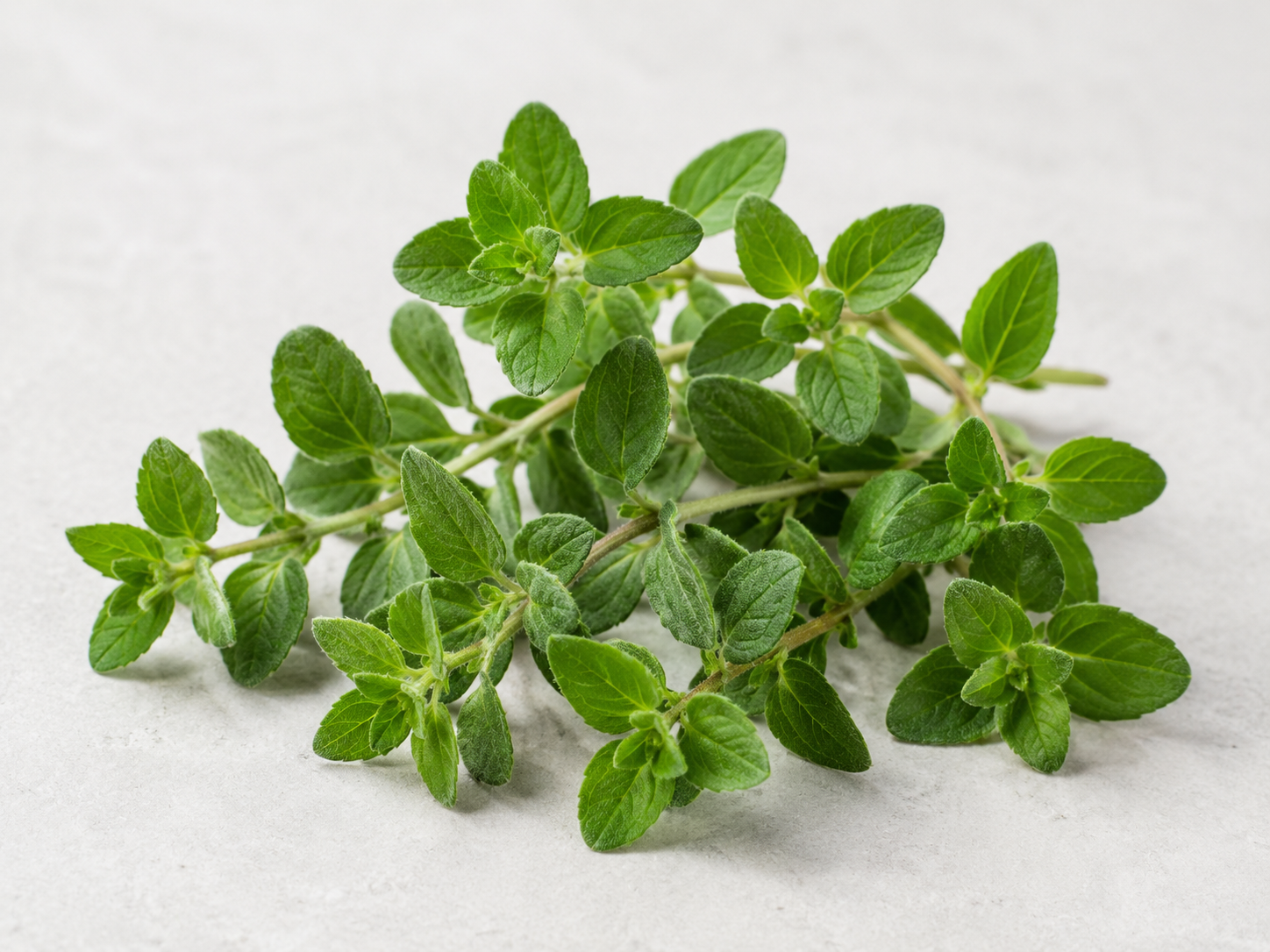
Spices and herbs · Herb spice
Oregano
Oregano is a perennial aromatic herb in the Origanum genus of the mint family. The edible parts are mainly the leaves and tender stem tips. Its flavor is herbal, spicy, and slightly bitter, and it is commonly used in tomato sauces, roasted vegetables, legumes, fish, and Mediterranean-style dishes. This page focuses on dried leaves of common oregano (Origanum vulgare L.). Dried oregano can look rich in fiber and minerals per 100 g, but a typical use is only about 1 g, so per-100-g values should not be mistaken for actual intake.
Food Overview
Key strengths
A small amount of oregano adds a strong herbal aroma to tomatoes, legumes, mushrooms, fish, and roasted vegetables. Representative compounds include carvacrol, thymol, and rosmarinic acid, but their proportions vary with subspecies, origin, harvest timing, and drying method.
How to use it
Add oregano to tomato stews, whole-grain pasta, bean soups, roasted vegetables, fish, tofu, or simple dressings. For braises, add some early for a cooked herbal note and a little near the end for a fresher aroma.
What stands out
The most important issue is not the mineral content per 100 g but the species and product form. Common dried oregano, marjoram, Mexican oregano, oregano essential oil, and oregano extracts should not share the same bioactive or safety data.
Worth noting
Oregano essential oil and extracts are far more concentrated than culinary dried leaves. Swallowing essential oil or using it incorrectly on the skin can cause poisoning, skin reactions, aspiration injury, and drug interactions. These products should not be used like a normal spice.
Basic Nutrition
Showing:100 g Dried oregano leaves
View complete nutrition data
GI note:GI varies with cultivar, food structure, processing, and cooking. Raw grains usually do not have directly applicable human GI data.
Reliable GI data for oregano are lacking, so GI is not estimated from nutrient composition. The page distinguishes a database value explicitly reported as 0 from data that are unavailable or cannot be determined reliably.
Data notes:On this page, “oregano” means common oregano, Origanum vulgare L. Basic nutrition uses dried oregano leaves as the only formal nutrition state; fresh/dried or cooked/raw switching is not provided.
The USDA entry is “Spices, oregano, dried” (FDC ID 171328), a generic dried-oregano entry that does not specify subspecies, cultivar, or chemotype. Sections 02 and 03 can be used as a basic reference for commercial dried oregano, but not as an exact profile for every Origanum vulgare sample.
Values default to per 100 g. A common serving is about 1 teaspoon dried oregano, or 1 g, calculated from the 100 g values. Because everyday use is usually about 1 g, the 100 g view should not be interpreted as actual intake.
GI is shown as “—” because reliable GI data suitable for an ordinary-food page are lacking. Oregano is used in very small amounts, and GI should not be estimated from total carbohydrate, sugar, or fiber or shown as 0.
The database does not provide a starch value suitable for this page, so starch is shown as “—” rather than calculated from total carbohydrate minus fiber and sugar.
Dried oregano contains some omega-3 and phytosterols per 100 g, but a 1 g seasoning amount provides very little, so these should not be presented as major nutritional advantages.
100 g is for standardized comparison only, not a recommended serving. A typical 1-teaspoon amount does not provide the high percentages shown in the 100 g table.
Vitamins & Minerals
Only vitamins and minerals providing at least 5% of the Daily Value are shown. At a common 1-teaspoon (1 g) serving, only vitamin K meets the display threshold. The 100 g view shows all nutrients reaching 5%, but 100 g is not a recommended serving.
At a common serving of about 1 teaspoon (1 g), only vitamin K reaches at least 5% of the Daily Value; other vitamins and minerals remain below 5%, so vitamin K is the only one shown by default. The 100 g view shows all nutrients reaching 5%, but 100 g is for comparison, not a recommended serving. Percentages use FDA Daily Values for adults and children age 4 and older.
View all vitamins and minerals
Percentages show how much the selected serving contributes to the adult Daily Value.
Key Bioactive Compounds
Carvacrol
Phenolic monoterpeneCarvacrol is a major source of oregano’s warm, spicy aroma and dominates some oregano chemotypes.
Amount: —. In essential oil from some oregano samples, carvacrol has made up about 56.2%–81.4%. That percentage describes the oil, not the weight of the whole leaf. Subspecies, chemotype, harvest time, and drying method can change it substantially.
Carvacrol shows antioxidant, antimicrobial, and inflammation-modulating activity in cell and animal studies, but ordinary culinary effects in people are uncertain.
Lightly crush dried oregano and add some early and some near the end of cooking.
Laboratory antimicrobial activity does not make oregano an antibiotic, disinfectant, or infection treatment; essential-oil doses and risks do not apply to dried leaves.
Rosmarinic acid
Phenolic acid compoundRosmarinic acid is a common polyphenol in mint-family herbs and an important nonvolatile compound in oregano.
Studies of common oregano and related subspecies report about 9.4–63.7 mg/g dry weight; another specific sample measured about 12.4 mg/g. Variety, origin, season, and method affect the result, so this is not a fixed commercial value.
It has antioxidant activity and has been studied in inflammation and metabolic health, but the effect of ordinary culinary amounts in people is unclear.
Add dried oregano directly to tomato, legume, mushroom, or vegetable dishes; prolonged high-temperature frying or switching to extracts is unnecessary.
Rosmarinic acid in oregano does not mean the herb treats chronic inflammation, diabetes, or cardiovascular disease.
Thymol
Phenolic monoterpeneThymol is a strongly herbal, spicy phenolic monoterpene and a major volatile in some oregano chemotypes.
Amount: —. Common oregano can be carvacrol-dominant, thymol-dominant, or another chemotype, so one value cannot represent all dried oregano. Environment, genetics, flowering stage, and processing affect the proportion.
Thymol shows antioxidant and antimicrobial activity in vitro, but most evidence does not come from people eating ordinary oregano.
Store oregano sealed, dark, and cool, and add a little near the end of cooking to preserve aroma.
In-vitro antimicrobial activity does not mean oregano can sterilize food or replace safe refrigeration, thorough cooking, or medical care.
How Preparation Changes Oregano
Fresh oregano
Fresh oregano is milder and suits salads, tomatoes, legumes, and finishing dishes. This page does not provide a standardized fresh nutrition state. As a rough flavor guide, 1 tablespoon chopped fresh oregano is about as strong as 1 teaspoon dried; this is not a nutrition conversion.
Dried oregano leaves
Drying reduces water and concentrates flavor per gram. Dried oregano suits stews, tomato sauces, bean soups, and roasted vegetables. Drying also changes essential-oil yield and carvacrol/thymol proportions, so dried is not automatically “more anti-inflammatory” than fresh.
Ground oregano powder
Grinding increases surface area, releasing aroma faster but also making it fade more quickly during storage. Whole or coarsely crushed dried leaves generally retain volatile aroma longer than fine powder.
Prolonged heating
Some volatile aroma compounds decline with prolonged heating. In braised dishes, add some oregano at the beginning for a cooked base note and a little near the end for aroma. Long high-temperature frying is not needed to “release” compounds.
Oregano essential oil and extracts
Essential oil, concentrates, and capsules are not another food state of dried oregano. Their active-compound concentrations, uses, and risks differ greatly and should not appear in the same basic nutrition selector.
Products not treated as food states
Fresh oregano does not currently have a numeric nutrition state on this page. Oregano essential oil, softgels, extracts, Italian herb blends, and salted oregano seasonings are also excluded because they cannot use plain dried-leaf nutrition data directly.
How to Choose and Store
How to choose
- Dried oregano leaves: favor products whose ingredient list contains only oregano, ideally labeled Origanum vulgare. Leaves should be naturally green-brown, distinctly herbal and spicy, dry and loose, with no damp clumping, insect damage, or musty odor. Sealed packaging with batch and production information is preferable.
- Adulteration matters: in the EU’s 2019–2021 coordinated control plan for herbs and spices, about 48% of tested oregano samples were considered suspicious for adulteration, commonly with plant materials such as olive leaves. This does not represent every country or brand, but it shows why authenticity deserves attention. Consumers cannot reliably detect adulteration by color or smell alone, so favor traceable, single-ingredient products with quality-testing information.
- Fresh oregano: choose naturally colored leaves and upright tender stems with no slime, blackening, extensive wilting, mold, or rotten odor, and keep it chilled after harvest.
How to store
- Dried oregano: store in an airtight container in a cool, dry, dark place away from the stove, steam, and sink. Whole or coarsely crushed leaves retain aroma longer than fine powder. Replace the product when aroma has faded substantially even if it has not spoiled.
- Fresh oregano: blot away excess surface moisture, refrigerate in a breathable or loosely closed container, and use promptly. Discard if it becomes slimy, blackened, moldy, or clearly rotten-smelling.
- Homemade oregano-infused oil: do not keep fresh oregano submerged in oil at room temperature for long periods unless a validated acidification method is used. Fresh-herb oils can create a low-oxygen environment favorable to Clostridium botulinum; use validated preparation methods, refrigerate, and consume promptly.
When buying oregano, remember three things: a single ingredient, a clear source, and a dry product with a noticeable aroma.
How to Use It in Everyday Meals
Tomato-oregano sauce
Add a little dried oregano while tomatoes, onion, and garlic simmer. Serve with whole-grain pasta, legumes, or roasted vegetables. Add some early for depth and a little near the end for fresher aroma. Use less refined sugar, cream, and salty commercial sauce.
Oregano-roasted vegetables
Toss oregano with broccoli, bell peppers, tomatoes, eggplant, squash, or mushrooms plus a little olive oil, then roast moderately. Avoid repeated high heat or obvious charring, and do not add large amounts of oil just for the herb compounds.
Oregano bean soup
Add oregano, black pepper, and a little garlic to chickpea, white-bean, lentil, or tomato-bean soup. Oregano adds flavor and can help reduce concentrated stock, salt, and processed meat.
Oregano fish or tofu
Season fish, chicken, or tofu with oregano, lemon juice, black pepper, and a little plant oil. Marinate in the refrigerator rather than at room temperature, then steam, bake, or cook with a small amount of oil.
Fresh oregano salad
Chop a little fresh oregano and combine with tomatoes, cucumber, legumes, whole grains, or plain cheese, dressed with vinegar, lemon juice, and a little olive oil. Fresh oregano is assertive, so start small and adjust to taste.
Whole-grain flatbread or pizza
Add dried oregano to whole-grain flatbread, tomato, and vegetable toppings. Emphasize vegetables, mushrooms, and legumes, and keep processed meat, heavy cheese, refined flour, and salty sauces moderate.
Who Should Take Extra Care
People allergic to oregano or other mint-family plants
If contact or eating causes mouth itching, rash, swelling of the face or lips, or breathing difficulty, stop using it and seek care as appropriate. People with a known allergy to thyme, basil, mint, or other mint-family herbs should be especially cautious when trying oregano.
People with sensitive digestion
Normal seasoning amounts are small, but large amounts of dried oregano, concentrated extracts, or oregano oil may irritate the mouth or gastrointestinal tract. Start with small amounts in food rather than swallowing dry powder directly.
Households with children
Oregano leaves used as a small food seasoning are very different from oregano essential oil. Keep essential oil out of children’s reach and do not let children swallow or apply it directly. Accidental ingestion can cause serious poisoning and aspiration injury.
People taking long-term medicines
Food seasoning amounts are far lower than doses in oregano capsules, extracts, and essential oils. People taking medication should check with a clinician or pharmacist before using concentrated oregano products and should not assume a “natural herb” cannot interact with medicines.
People making homemade herb oils
Do not keep unvalidated fresh-oregano oil at room temperature for long periods. Use acidification and storage methods validated by food-safety authorities, or make small amounts, refrigerate, and use promptly.
People buying bulk or untraceable products
Dried herbs are not sterile. Oregano products have been recalled for Salmonella contamination. Follow regulatory notices and avoid products with damaged packaging, dampness, mold, or unclear origin.
Similar Food Alternatives
Marjoram
Usually Origanum majorana, a different species. It is milder and sweeter and suits soups, chicken, legumes, and vegetables; common-oregano data do not apply directly.
Thyme
More woody and herbal, with a savory-spicy note. Good in stews, mushrooms, legumes, fish, and roasted vegetables.
Basil
Fresher and slightly sweet; good with tomatoes, salads, legumes, and pasta. Add fresh basil near the end of cooking.
Rosemary
More piney and camphoraceous; useful with roasted root vegetables, fish, and legumes. Use less because its flavor is stronger.