Fermented foods · Dairy and fermented foods
Traditional kefir
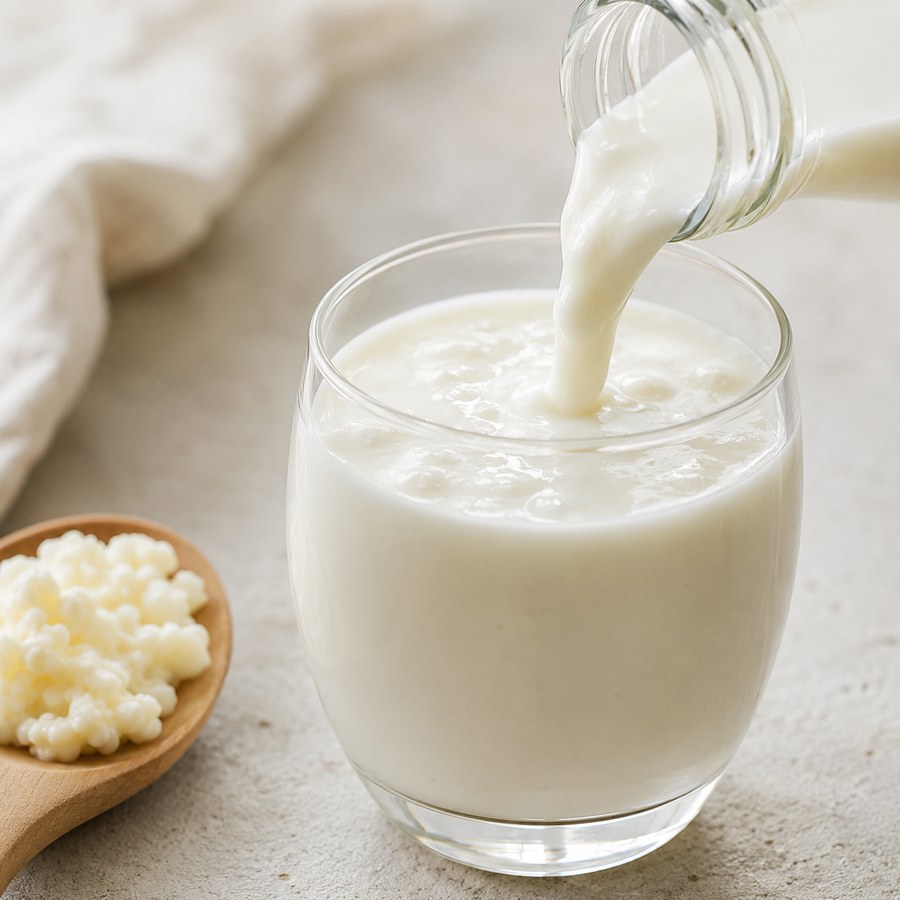
Traditional kefir is a tart fermented milk drink made by adding kefir grains to milk, where lactic-acid bacteria, acetic-acid bacteria, and yeasts ferment together. It is often lightly carbonated, slightly yeasty, and thinner than yogurt. Codex descriptions of kefir likewise emphasize a mixed community originating from kefir grains. Nutrition here uses one traceable representative product: plain 1.5%-fat milk kefir from the Danish DTU Frida database. The default view is per 100 g; a common serving is about 200 mL (roughly 200 g). Homemade products can vary widely in lactose, microbes, acidity, and alcohol.
Food overview
Key strengths
Traditional kefir provides milk protein, calcium, phosphorus, vitamin B2, and vitamin B12 together with live lactic-acid bacteria, yeasts, and fermentation metabolites. Its microbial community is usually more complex than standard yogurt, but composition is not fixed.
Best ways to use it
Drink it plain or use it in overnight oats, fruit-and-nut bowls, cold soups, dressings, and smoothies. If live microbes are the goal, use it chilled rather than boiled. In baking or hot dishes it still provides protein and minerals, but should no longer be promoted mainly for live cultures.
What stands out
Traditional kefir is not a product with one fixed composition. Microbial species, acid production, kefiran, and alcohol can vary substantially between kefir grains, and homemade and industrial products should not automatically share the same data.
Worth noting
Fermentation usually lowers lactose, so some people with lactose intolerance may tolerate kefir better than milk. It is not lactose-free and is not suitable for cow’s-milk protein allergy. Traditional kefir may also contain small, variable amounts of alcohol.
Basic Nutrition
Showing:100 g Plain traditional milk kefir
View complete nutrition data
GI note:GI varies with cultivar, food structure, processing, and cooking. Raw grains usually do not have directly applicable human GI data.
There is no reliable representative GI value for traditional plain kefir with a clearly defined test product and fermentation method. Do not infer one from lactose, acidity, or ordinary milk, and do not display 0.
Data notes:This page uses one nutrition state: plain traditional milk kefir. Values vary with milk fat, kefir-grain ratio, microbial source, fermentation temperature, and time, so one database profile should not be treated as universal.
Basic nutrition uses the Danish DTU Frida entry “Milk, 1.5% fat, cultured, kefir.” The default is per 100 g; a common serving is about 200 mL. Frida lists this representative product at roughly 1 g/mL, so 200 mL is treated as about 200 g.
This entry represents 1.5%-fat milk kefir, not full-fat, homemade, long-fermented, or every retail brand. When a packaged product provides its own nutrition label, use that product-specific data first.
GI is shown as “—”. There is no sufficiently clear, representative GI value for traditional plain kefir with a consistent test product and fermentation method, so GI should not be inferred from lactose content, acidity, or milk GI.
Alcohol is shown as 0 g only for this database sample. Because yeasts participate in traditional kefir fermentation, other products may contain detectable alcohol; do not apply 0 g to all homemade or retail kefir.
One household-kefir study found about 3.15 g protein, 1.28 g fat, and 4.91 g carbohydrate per 100 mL, with lactose about 13.6% lower than unfermented control milk. This illustrates how traditional kefir can differ from a standard database entry.
Vitamins & Minerals
Only vitamins and minerals providing at least 5% of the FDA Daily Value for adults and children age 4+ are shown. The default list displays the top six qualifying nutrients; at about 200 g, potassium is about 306 mg or 7% DV and appears in the expanded list.
At the default 100 g serving, only vitamin B12, calcium, vitamin B2, phosphorus, iodine, and pantothenic acid reach at least 5% of the adult Daily Value. At about 200 g, potassium rises to roughly 306 mg, about 7%, and appears in the expanded list. Values vary with milk source, fat level, season, and brand; use a product’s own label when available.
View all vitamins and minerals
Key Bioactive Compounds
Live lactic-acid bacteria and yeasts
Live microbial communityTraditional kefir is fermented by lactic-acid bacteria, acetic-acid bacteria, and yeasts.
Codex standards generally expect about at least 10⁷ CFU/g total fermenting microorganisms and 10⁴ CFU/g yeasts through shelf life. Species and counts vary with grains, culture conditions, and storage.
Human studies suggest modest effects on some gut microbes, but results are inconsistent. A 2026 review of 8 intervention studies found limited, variable changes.
Choose refrigerated plain kefir with live cultures and no post-fermentation heat treatment. Drink it cold or add it to cooled foods.
Kefir microbes do not necessarily permanently colonize the gut, and kefir is not proven to rebuild the microbiome, treat enteritis, or replace medication.
Kefiran
Microbial exopolysaccharide (kefiran)Kefiran is a viscous exopolysaccharide made by some kefir bacteria and helps form kefir grains and texture.
Reviews commonly report about 50–200 mg/L exopolysaccharides in commercial kefir; one experiment measured about 84.0 mg/L. Levels vary with strains, fermentation, filtration, and storage.
Cell and animal studies suggest possible immune, antioxidant, and gut-environment effects, but human clinical evidence remains limited.
Drink the whole kefir rather than isolating grains or sediment. Very long fermentation has not been proven more beneficial.
Kefiran is not a proven anti-inflammatory or gut treatment, and experimental doses cannot be directly converted to one cup of kefir.
Fermentation peptides and organic acids such as lactic acid
Fermentation metabolitesFermentation breaks some milk protein into peptides and produces lactic acid, small amounts of acetic acid, and other metabolites.
One study identified 257 peptides, including 236 not seen in unfermented milk. Household kefir studies measured about 0.59–0.63 g lactic acid per 100 mL; profiles vary by process.
Some peptides and organic acids show antioxidant, antimicrobial, or immune-related activity in experiments, and lower pH helps shape kefir’s storage environment.
Cold use preserves more live microbes. Cooking still leaves protein, calcium, and some nonliving metabolites.
Experimental peptide activity does not mean one cup of kefir lowers blood pressure, treats infection, or removes inflammation; more sour is not proven better.
How processing changes it
Milk before fermentation
Milk provides protein, calcium, lactose, and milk fat but lacks the mixed kefir-grain community, kefiran, and characteristic fermentation peptides. Fermentation uses some lactose and produces lactic acid, but the amount of change varies.
Fresh traditional kefir
Freshly fermented kefir is usually moderately tart, contains live lactic-acid bacteria and yeasts, and may be lightly fizzy. Microbial counts, acidity, lactose, and alcohol depend on grain ratio, temperature, and fermentation time.
Cold maturation
After refrigeration, microbial metabolism slows but may not stop completely. Kefir can become more acidic, more fizzy, or separate some whey. In one household study, macronutrients changed little over 48 hours of refrigeration, but that is not a universal storage limit.
Heating after fermentation
Thorough heating markedly reduces or inactivates live bacteria and yeasts. Heated kefir still provides protein, calcium, lactose, and some fermentation metabolites, but should not be marketed mainly as a live-culture food. Codex viability requirements for fermented milk assume no post-fermentation heat treatment.
Strained thick kefir
Removing some whey makes kefir thicker and can change the per-100 g concentrations of protein, fat, and lactose. Strained products should not continue using ordinary liquid-kefir nutrition values.
Flavored or sweetened kefir
Fruit puree, syrups, juice, and flavorings change energy, carbohydrate, and sugar. Flavored products should use their own labels rather than the plain-kefir value of 3.78 g sugar per 100 g.
Water kefir and plant-based kefir
Water kefir uses sugar water or juice, while plant-based versions use soy, oat, coconut, or other bases. Protein, fat, calcium, and microbial conditions differ from milk kefir and deserve separate food entries.
How to choose and store it
How to choose
- Check the product name and fermentation method: favor products clearly labeled kefir, kefir-grain fermented, or describing joint fermentation by lactic-acid bacteria and yeasts. “Lactic-acid-bacteria drink” or generic “fermented milk” may not be traditional kefir.
- Check for live cultures: if you want active microbes, choose refrigerated products labeled with live cultures and not marked as heat-treated after fermentation.
- Check ingredients: favor plain products based mainly on milk and fermentation cultures. Fruit kefir may contain syrup, fruit-juice concentrate, flavorings, or sweeteners, so check sugar per 100 g.
- Check the milk source: choose pasteurized milk. Home fermentation cannot reliably make raw milk safe from Salmonella, E. coli, or Listeria; pregnant people, children, older adults, and immunocompromised people should especially avoid raw-milk kefir.
- Check the package: it should be intact without leakage or abnormal swelling. Mild fizz can come from yeast, but marked expansion, spraying, rotten odor, or unusual discoloration should not be dismissed as “more live cultures.”
How to store
- Keep continuously refrigerated: refrigerate promptly after purchase and follow the label. Do not leave kefir at room temperature or in a hot car for long periods, because fermentation continues and food-safety risk can rise.
- Use soon after opening: pour with clean utensils and avoid drinking directly from the bottle before prolonged storage. Follow the product’s opened-use guidance; homemade kefir should not borrow the shelf life of commercial products.
- Whey separation: a little pale-yellow whey is not necessarily spoilage and can be gently mixed back in. Discard if there is mold, pink or green discoloration, rotten odor, unusual bitterness, or excessive gas production.
Remember three points: choose plain, low-sugar products; use pasteurized milk; and keep the product refrigerated with live cultures.
How to use it in everyday meals
Drink It Plain
About 150–200 mL at a time can replace milk or yogurt. People new to fermented dairy, with poorer lactose tolerance, or prone to bloating can start with 50–100 mL. Choose plain products rather than adding honey, syrup, or large amounts of juice.
Kefir overnight oats
Mix oats with kefir and refrigerate, then add blueberries, strawberries, kiwi, walnuts, or flaxseed. Cold use preserves live cultures, while fruit and whole grains add fiber. Avoid lots of sugar or sweetened granola.
Kefir fruit-and-nut bowl
Pour kefir over fruit, nuts, and seeds such as berries, apple, chia, and oats. Thicker products can work like a yogurt bowl. Dried fruit, sweet granola, and flavored nuts can add substantial sugar or salt.
Kefir smoothie
Blend briefly with berries, banana, spinach, or unsweetened cocoa. Fruit usually provides enough sweetness, so added sugar is unnecessary. Drink soon after making rather than leaving it at room temperature for hours.
Cold kefir dressing
Mix with lemon juice, dill, parsley, black pepper, and a little salt for salads, grilled fish, legumes, or whole-grain bowls. It is lighter than many cream sauces, though salt and salty preserved ingredients still matter.
For marinades or baking
Kefir’s acidity can be useful for marinating fish or poultry and in whole-grain pancakes or breads. Heating greatly reduces live microbes, so these uses are mainly about acidity, protein, and cooking function—not probiotic delivery.
Who Should Take Extra Care
People with cow’s-milk protein allergy
Kefir still contains casein and whey proteins. Fermentation does not remove milk allergens completely, so traditional milk kefir is not a safe substitute for people with cow’s-milk protein allergy.
People with lactose intolerance
Some people tolerate kefir better than milk. A small randomized crossover trial found improved lactose digestion and tolerance with kefir and yogurt in some participants, but kefir still contains lactose and responses vary. Start with a small serving and watch for bloating, pain, or diarrhea.
Pregnant people, infants/young children, older adults, and immunocompromised people
Choose commercial products made from pasteurized milk with a clear production process and cold chain. Avoid raw-milk kefir and homemade products with uncertain hygiene or fermentation conditions. People with severe immune suppression should ask a clinician before using high-live-count products.
People sensitive to fermented foods or acidic drinks
Kefir’s acidity, carbonation, and fermentation metabolites can trigger reflux, bloating, or bowel sounds in some people. Reduce the serving, drink it with meals, or choose a less strongly fermented product.
People who strictly avoid alcohol
Yeasts participate in traditional kefir fermentation, so alcohol can range from near zero to detectable amounts and varies more in long-fermented homemade products. During pregnancy, for children, for religious reasons, or when alcohol must be strictly avoided, check product information and avoid homemade products with unclear fermentation and storage.
People with impaired kidney function
A representative 200 g serving provides about 191 mg phosphorus, 306 mg potassium, and roughly 7 g protein. People restricting protein, phosphorus, potassium, or fluids should fit kefir into their individual treatment plan.
People managing blood sugar
Prefer plain products with no added sugar. Lactose in plain kefir is natural sugar, while flavored products may add sucrose, syrups, or juice concentrate; check the label rather than assuming all fermented milk is low in sugar.
Similar Food Alternatives
Plain live-culture yogurt
Also provides protein, calcium, and live lactic-acid bacteria, with more standardized nutrition labeling and cultures. It is usually thicker than kefir and has a different microbial diversity and yeast profile.
Plain drinkable yogurt
Closest to kefir in how it is consumed and useful with oats or fruit. Check added sugar, and note that not all drinkable yogurts contain yeasts or kefiran.
Cultured buttermilk
Has a fresh acidic taste and works for drinking, dressings, marinades, and baking. Its cultures are usually simpler than traditional kefir and it may not contain kefir-grain-derived polysaccharides or yeasts.
Plain lactose-free yogurt
Better suited to people with lactose intolerance who do not have milk-protein allergy. It is still dairy and is not safe for milk-protein allergy, and its microbes are not the same as traditional kefir.