Whole Grains & Tubers · Tubers
Chinese Yam
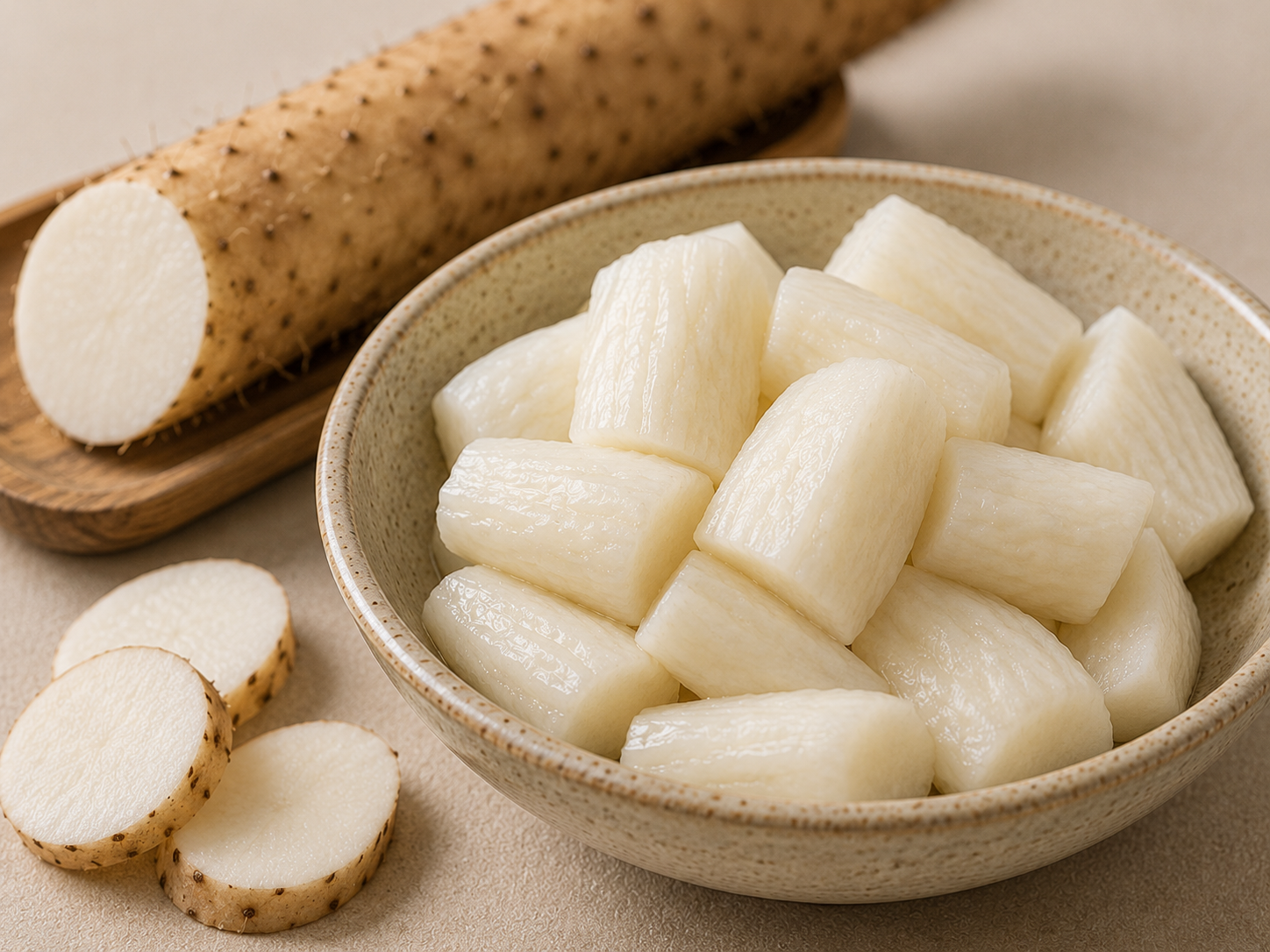
Chinese yam is a high-moisture starchy tuber that provides carbohydrate, potassium, copper, vitamin B1, and vitamin B5. It can replace part of rice or noodles, but it is not especially high in dietary fiber, and there is no reliable evidence that an ordinary serving treats stomach disease, diabetes, or inflammation.
Food Overview
Key strengths
Fresh Chinese yam provides about 64 kcal, 13.9 g of carbohydrate, and 2.2 g of protein per 100 g, along with notable amounts of potassium, copper, vitamin B1, vitamin B5, and a small amount of vitamin C.
How to Eat It
Chinese yam can be steamed, boiled, stewed in soup, briefly stir-fried, or cut into chunks and added to mixed-grain rice and grain bowls.
What stands out
Chinese yams on the market vary considerably. Common long yam usually contains more water and has a crisp texture; Tiegun yam and some mealier cultivars may contain less water and more starch; types such as Yamatoimo and Jinenjo are also more viscous.
Worth noting
Reliable human GI data are not available for fresh or boiled Dioscorea polystachya, so both states are shown as “—”.
The often-cited GI of about 52 comes from a study where “yam” meant sweet potato, not the Chinese yam discussed here.
Basic Nutrition
Showing:100 g Raw Chinese Yam
View complete nutrition data
GI note:GI varies with cultivar, food structure, processing, and cooking. Raw grains usually do not have directly applicable human GI data.
No standard human GI value reliably represents fresh Chinese yam.
Data notes:Raw Chinese-yam data come from entry 02023 of the Japanese food-composition tables; boiled Chinese-yam data come from entry 02024.
“Sugars” is not a single total-sugars field provided directly by the database but an approximate value obtained by adding glucose, fructose, and sucrose.
Fatty-acid values for boiled Chinese yam are estimated by the database from the raw-yam entry and are appropriate for representative display rather than being interpreted as precise values independently measured in an experiment.
No reliable GI data match the species, processing state, and human testing conditions of fresh Chinese yam.
Vitamins & Minerals
By default, show values per 100 g of raw Chinese yam and only representative nutrients providing at least 5% of the adult Daily Value at the current serving
View all vitamins and minerals
Percentages show how much the selected serving contributes to the adult Daily Value.
Key Bioactive Compounds
Chinese-Yam Mucilage Polysaccharides
Functional PolysaccharidesThe mucilage released when Chinese yam is cut or grated is made up of polysaccharides, glycoproteins, and other water-soluble components.
Yam species and cultivars differ greatly in mucilage amount, water content, and extraction method, and no unified per-100 g fresh-yam value is available. Specific amount: —.
Mucilage polysaccharides can contribute fermentable carbohydrate to the diet and may support gut microbes and a normal intestinal environment.
Chinese yam can be steamed, boiled, stewed, or briefly stir-fried.
Chinese-yam mucilage does not form a permanent protective film in the stomach and does not treat gastritis, gastric ulcers, or intestinal disease.
Resistant Starch
Functional carbohydratesChinese yam contains substantial starch, part of which may resist digestion under some raw or cooked conditions.
Specific amount: —. Starch structure varies among Dioscorea cultivars; cooking reduces native resistant starch, while some may reform during cooling.
Some resistant starch can reach the colon and be used by gut microbes, contributing to short-chain fatty-acid production.
Ordinary Chinese yam should be cooked thoroughly. Only known cultivars intended for raw use should be eaten raw.
Chinese yam remains a starchy food; resistant starch does not remove the need to control portions or make chilled yam a diabetes treatment.
Dioscorin
Plant Storage ProteinDioscorin is one of the major storage proteins in yam tubers and is also referred to as Dioscorin in some studies.
Specific amount: —. Yam species, cultivars, and analytical methods differ substantially. Research often uses isolated protein or extracts that cannot be converted into one standard fresh-yam value. It is distributed mainly in tuber flesh cells.
Isolated dioscorin has shown antioxidant and enzyme-inhibitory activity in vitro, but the magnitude of any effect from ordinary cooked yam intake in people is unclear.
Normal steaming, boiling, or stewing provides the yam’s protein; there is no need to buy yam-protein or dioscorea extracts separately.
In-vitro enzyme inhibition, antioxidant tests, and animal studies do not prove that eating Chinese yam lowers blood pressure, boosts immunity, or treats tumors.
How Preparation Changes Chinese Yam
Long Yam vs Mealier Yam Types
The data on this page mainly represent higher-moisture long-yam types. Even when these products are the same or closely related species, their energy, carbohydrate, and water values per 100 g are not guaranteed to be identical.
Raw Chinese Yam
When the product is clearly identified as an edible Chinese yam, it can be peeled and sliced or grated for raw use.
Steamed Chinese Yam
Steaming avoids immersing the yam directly in water and may reduce the transfer of some water-soluble components into cooking liquid.
Boiled Chinese Yam
In the database, boiled Chinese yam is prepared by removing the surface, rootlets, and cut ends, cutting it into half-moon pieces about 3—5 cm thick, boiling in water, and draining.
Stir-Fried or Roasted
Brief stir-frying can preserve some crispness, while longer heating makes the yam soft and mealy. Roasting reduces water and concentrates the yam flavor and starchy texture.
Chinese-Yam Mash & Grated Yam
Grating or mashing disrupts the intact chunk structure and makes it easier to consume a large amount in a short time.
Dried Chinese-Yam Slices & Yam Powder
Dried Chinese-yam slices, yam powder, and medicinal slices have lost much of their water, so energy, starch, and nutrient density per 100 g are much higher than in fresh yam. Fresh-yam nutrition data and common serving sizes therefore do not apply.
Cooling & Reheating
Cooling cooked Chinese yam may allow some gelatinized starch to retrograde, but human evidence is insufficient to establish a fixed reduction in GI after refrigeration.
How to Choose & Store
How to choose
- First confirm the product is Chinese yam, fresh Chinese yam, long yam, nagaimo, Huai yam, Chinese yam, or Nagaimo.
- Prefer fresh yams that feel firm overall, have relatively intact skin, and show no mold, extensive soft decay, leaking, or abnormal odor.
- The cut surface should be white or creamy white and firm. Mild browning can be normal oxidation, but a sour or moldy smell together with soft decay is a reason to discard it.
- Common long yam contains more water and is suitable for stir-frying, chilled dishes, mealy types are better steamed as part of the staple-food portion.
- People sensitive to yam juice can wear gloves when peeling and avoid touching the eyes or face.
- For yam powder, yam noodles, yam cakes, yam chips, and ready-to-eat yam mash, check the proportion of yam, wheat flour, syrup, oil, sodium, non-dairy creamer, cream, and butter.
How to store
- Wrap uncut Chinese yam in paper and store it in a cool, dry, dark, ventilated place; in hot, humid weather it can be kept in the refrigerator’s produce area.
- Cover the cut surface tightly with plastic wrap or place it in a sealed container in the refrigerator and use promptly.
- Refrigerate cooked Chinese yam within 2 hours; if the ambient temperature is above 32°C, refrigerate within 1 hour.
- Refrigerated cooked leftovers are generally best eaten within 3—4 days.
- Discard yam with obvious mold, extensive soft decay or leaking, sour, moldy, or fermented odors, abnormal discoloration together with decay, or unusual sliminess on cooked surfaces.
When buying Chinese yam, remember three things: identify the edible type, choose firm roots without soft decay, and check the actual yam proportion in powders and pastries.
How to Include It in Everyday Meals
Steamed Chinese Yam
Wash and peel the Chinese yam, cut it into large sections, and steam until chopsticks can pass through easily.
Chinese-Yam Soup
Cut yam into chunks and stew it with chicken, fish, ribs, tofu, mushrooms, carrot, or corn. Add the yam closer to the end of cooking so it does not completely disintegrate.
Chinese-Yam Mixed-Grain Rice
Cut yam into large chunks and cook it with white rice, brown rice, millet, or quinoa. Because yam itself contributes carbohydrate, reduce the amount of dry rice accordingly rather than adding yam on top of the original rice portion.
Stir-Fried Chinese Yam
Slice Chinese yam and stir-fry briefly with wood ear mushrooms, snow peas, carrot, celery, or bell pepper to retain some crispness.
Chinese-Yam Mash
Mash steamed yam and combine with milk, unsweetened soy milk, tofu, or a small amount of chopped nuts for people with weaker chewing ability. Because smooth mash is easy to eat quickly, control the amount of raw yam used and limit butter, cream, condensed milk, and added sugar.
Chinese-Yam Grain Bowl
Pair chunks of steamed or boiled Chinese yam with brown rice, quinoa, lettuce, red cabbage, tomato, legumes, and egg.
Who Should Take Extra Care
People managing blood sugar
Chinese yam is still a starchy, carbohydrate-containing tuber. Raw Chinese yam provides about 13.9 g of carbohydrate per 100 g, including about 11.8 g of starch.
No reliable human GI data are available for fresh Chinese yam, so it should not be fixedly labeled as a low-GI food.
People with impaired kidney function
Both raw and cooked Chinese yam contain about 430 mg of potassium per 100 g. People who need to limit potassium should not increase intake freely simply because it is a natural food and should adjust portions according to a plan from a physician or registered dietitian.
People with Sensitive Skin or Mucous Membranes
Itching or prickling after peeling or handling raw yam juice may be related to mechanical irritation from needle-shaped calcium oxalate crystals.
If eating yam causes lip swelling, throat tightness, wheezing, or generalized hives, do not treat it as ordinary contact itching; stop eating and seek medical care promptly.
People eating it raw
Only consider eating it raw when the product is clearly identified as an edible Chinese-yam type, from a reliable source, and stored appropriately.
Raw-yam consumption also requires clean hands, knives, and cutting boards. Infants and young children, pregnant people, older adults, and people with weakened immune systems are better served with thoroughly cooked Chinese yam.
Infants, young children, and people with swallowing difficulties
Cook until soft, remove the skin and hard pieces, then mash or cut to a size appropriate for age and swallowing ability.
People with Celiac Disease or on a Strict Gluten-Free Diet
Plain fresh Chinese yam does not belong to wheat, barley, or rye and can be used as a gluten-free ingredient. However, yam noodles, yam cakes, yam cookies, and composite yam powders may contain wheat flour or have production cross-contact, so check ingredient lists and gluten-free labeling.
Similar Food Alternatives
Sweet potato
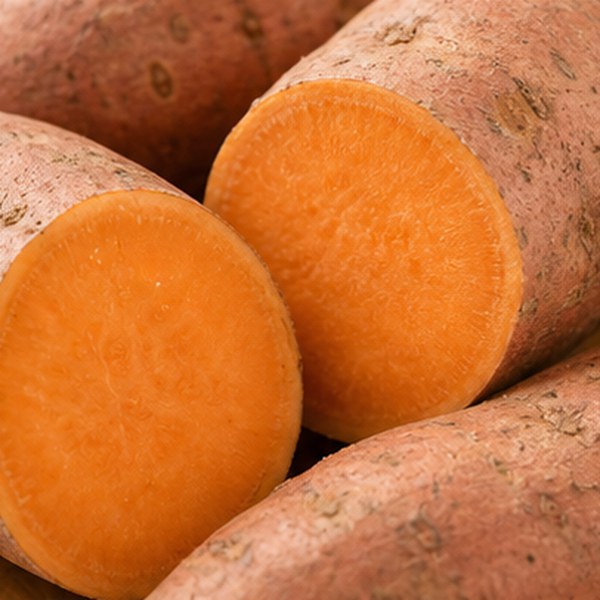
It is also a starchy tuber suitable for steaming, boiling, and roasting.
View details →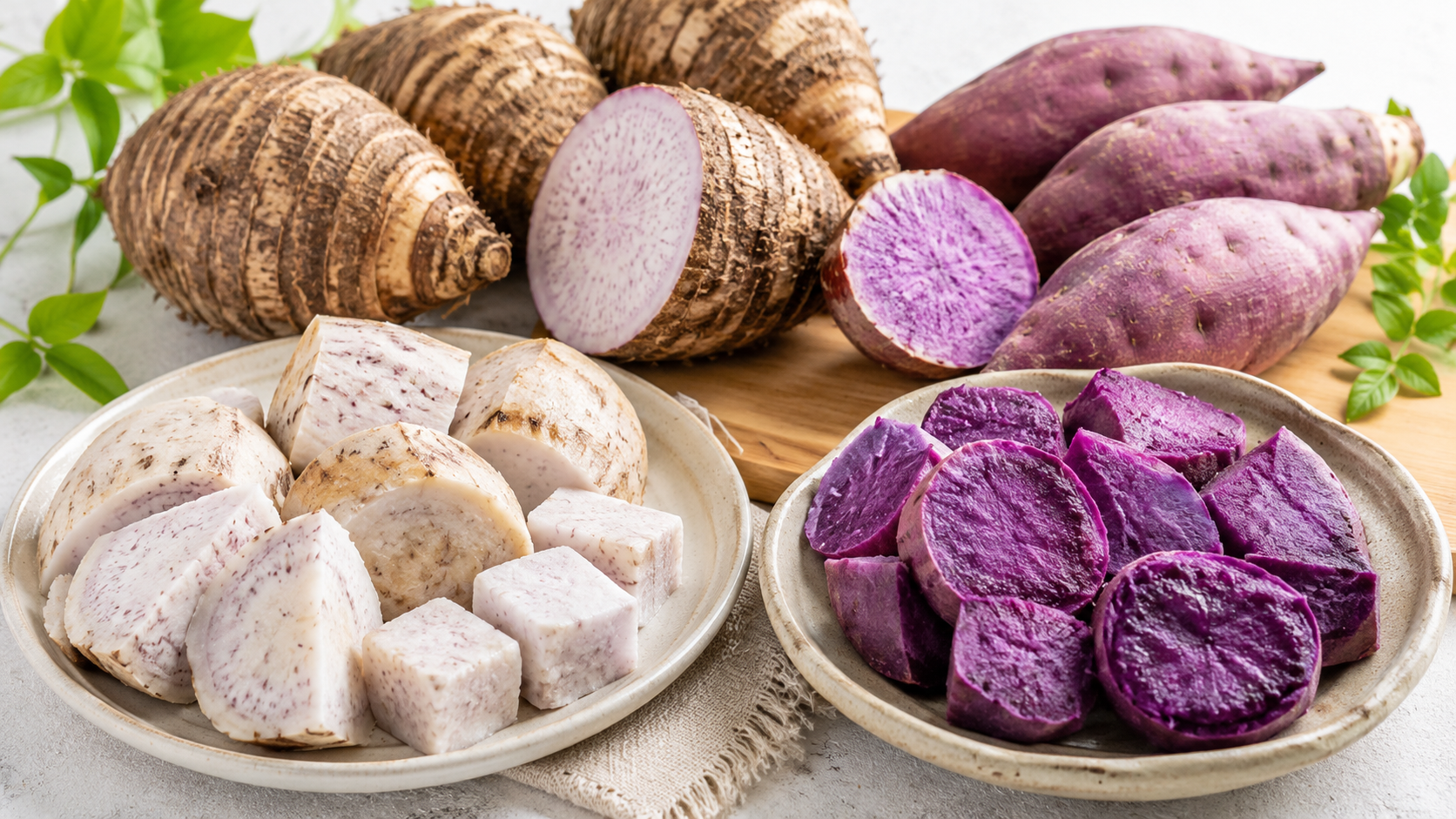
Taro
Taro can replace part of the staple food and works steamed, boiled, or stewed. It must be cooked thoroughly because of calcium oxalate and other irritants.
View details →Potato
It can also serve as part of the staple-food portion and works well steamed, boiled, stewed, or roasted.
View details →
Lotus Root
It has a distinctive texture both raw and cooked and works well stir-fried, chilled, or stewed in soup.
View details →Data Sources & Last Updated
Nutrition Data
Basic Information & Food Safety
Research & References
Epping, J., & Laibach, N. (2020). An underutilized orphan tuber crop—Chinese yam: a review.
Planta, 252, 58. DOI / Original
Wang, Z., et al. (2023). Dioscorea spp.: Bioactive Compounds and Potential for the Treatment of Inflammatory and Metabolic Diseases.
Zou, J., et al. (2023). The structure-glycemic index relationship of Chinese yam (Dioscorea opposita Thunb.) starch.
Food Chemistry, 421, 136228. DOI / Original
Lin, M. H. A., et al. (2010). Glycemic index, glycemic load and insulinemic index of Chinese starchy foods.
World Journal of Gastroenterology, 16(39), 4973–4979. DOI / Original